

You manage a departmental road network, a logistics car park or the roads of a business park, and every summer brings the same calls: a road that sticks to tyres, chippings pulled out, a shiny black surface that becomes slippery. This phenomenon has a name: bleeding. The French Ministry of Transport considers it rare and attributes it to a fault in formulation or laying, in a parliamentary answer published on 8 September 2026. Repeated heatwaves nevertheless make it more visible every year.
Bitumen bleeding: what it is
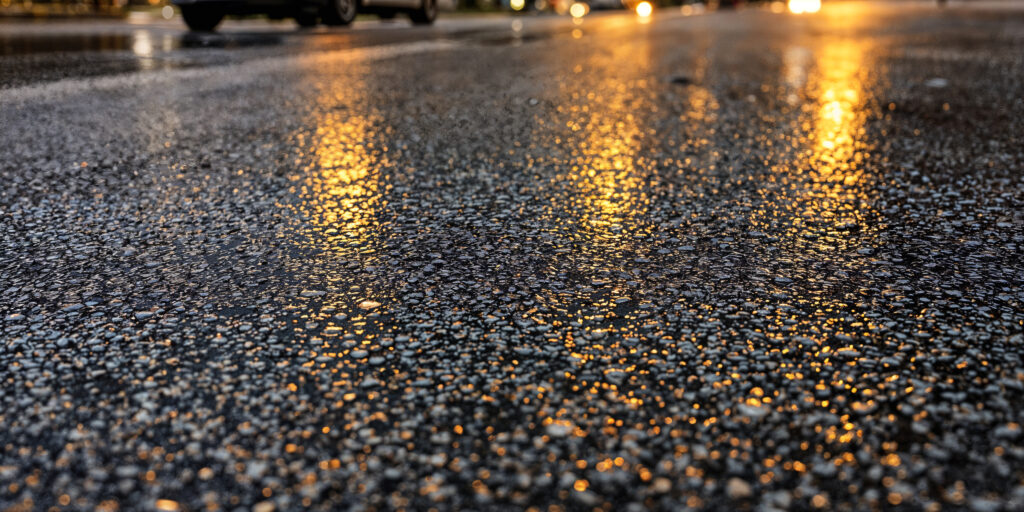
Bleeding is the migration of bitumen to the pavement surface under the effect of loads, especially in great heat. The binder driven upwards forms a film that covers the aggregates. The surface loses its texture, and the Loir-et-Cher department describes dangerous areas of reduced grip, particularly for two-wheelers. The aggregates stick to tyres and the layer deteriorates quickly.
Why a heatwave triggers bleeding
Bitumen softens with heat. Its sensitivity is measured by the ring-and-ball softening point, the temperature at which a sample gives way under the weight of a steel ball. For the common grades of NF EN 12591, this point lies between 43 and 58 °C, according to the matching data sheets of two refiners.
| Binder | Ring-and-ball softening point | Use |
|---|---|---|
| Bitumen 160/220 | 35 to 43 °C | Cold climates, surface dressings |
| Bitumen 70/100 | 43 to 51 °C | Light traffic, temperate climate |
| Bitumen 50/70 | 46 to 54 °C | Common use in France |
| Bitumen 35/50 | 50 to 58 °C | Heavy traffic, hot climate |
| Modified bitumen PmB 25/55-65 | 65 °C minimum | Great heat, rutting areas |
The surface of a pavement in the sun goes well beyond the ambient air temperature. Published measurements record 64 °C for air at 44 °C, and a thermal camera measured 65 °C on London asphalt on 24 June 2026, for air at about 35 °C. On the A10, Université Gustave Eiffel measured 45.3 °C at a depth of only 2.5 cm on a June afternoon, while the modulus of asphalt falls sharply with temperature. In a heatwave, the surface therefore exceeds the softening point of all common road bitumens. This is why laboratories test the rutting resistance of asphalt at 60 °C. The concepts of penetration and softening point are detailed in our dedicated guide.
The causes that turn heat into bleeding
Heat alone is not enough: a well-formulated pavement withstands heatwaves. Bleeding appears when the asphalt contains too much binder for its voids, or when the binder is too soft for the climate and the traffic. The causes recorded by road managers are concrete. An over-applied tack coat enriches the asphalt with bitumen from below; we detailed this point in the article on emulsion application errors. An over-applied surface dressing bleeds in its first summer, and the Luxembourg specifications reduce the rate by 5% on a smooth substrate and by 10% on a substrate that already bleeds. Spot repairs done by hand, known as manual patching, often lead to excess binder. Contamination by fuel also softens bitumen: the Quebec Ministry of Transport measured that with 8% diesel, the high-temperature resistance of the binder falls by more than 20 °C.
Bitumen grade, the first line of prevention
A harder bitumen resists heat better. In the south, on a road with heavy traffic or a braking zone, a 35/50 or a polymer-modified bitumen usefully replaces 50/70. Modified bitumen PmB 25/55-65 has a softening point of at least 65 °C. This choice is reasoned with traffic and climate, as explained in our article choosing your bitumen grade and in our comparison pure bitumen or modified binder. Formulas for heavy goods vehicles are covered in the article onasphalt for heavy traffic.
Treating a pavement that bleeds
Emergency treatment consists of giving texture back to the surface. Fine chipping or sanding absorbs the excess bitumen and restores grip. Over Whitsun 2026, the Calvados department closed the RD 16 for about a week, as the surfacing was sticking to wheels over more than a kilometre, and spread a mixture of sand and chippings.
Milk of lime, a mixture of slaked lime and water, is used both preventively and curatively. It whitens the pavement and reduces its temperature: the departments that use it report a fall of about 10 °C. The department of Loir-et-Cher estimates its effect at around ten days if traffic is light and it does not rain, and puts the cost of the spreader at about 100,000 euros for a capacity of 40,000 m². It treated about 70 km of departmental roads during the summer of 2021, and Rhône several dozen kilometres in June 2026. Milk of lime buys time without correcting the cause, and a layer that bleeds every summer ends up being planed off and relaid with a suitable formula.
What E-Station does
We supply 35/50 and 50/70 road bitumens compliant with NF EN 12591 and modified bitumens for hot regions and heavily trafficked pavements, particularly in Africa and the Middle East, with a certificate of analysis. Our comparison of grades helps you choose, and our terms are on the page bitumen trading.
Frequently asked questions
What is pavement bleeding?
The rise of bitumen to the pavement surface under the effect of loads and heat. The film of binder covers the aggregates and makes the surface slippery, especially for two-wheelers.
At what temperature does a pavement bleed?
The surface of a pavement in the sun can exceed 60 °C in a heatwave, above the softening point of common bitumens, which lies between 43 and 58 °C.
How can bleeding be avoided?
By applying the binder and the tack coat at the correct rate, and by choosing a harder bitumen, such as a 35/50 or a polymer-modified bitumen, in hot areas or under heavy traffic.
Why is milk of lime put on roads in summer?
It whitens the pavement, reduces its temperature by about 10 °C according to the departments and limits bleeding for one to two weeks.
What should be done on a road that bleeds?
Fine chipping or sanding as an emergency measure to restore grip. If the defect returns every summer, the layer must be relaid with a suitable formula.
Choosing a bitumen for a hot region? Request a quotation →