
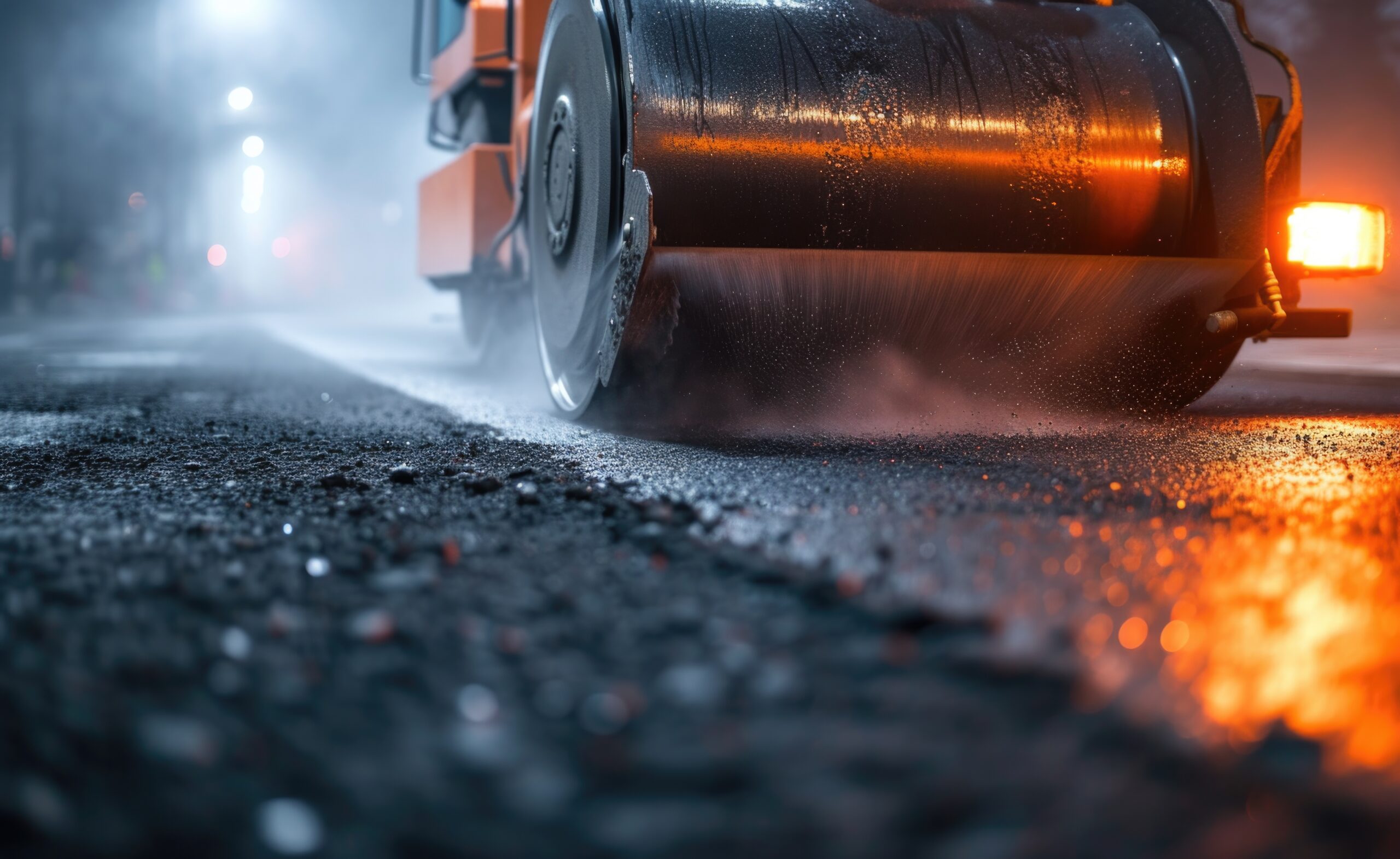
Under heavy traffic, a poorly designed pavement ruts quickly: repeated passes by heavy trucks dig grooves into the wearing course, creating a safety risk and a high repair cost. Choosing the right asphalt mix for these roads is far from a detail: it is what makes a pavement last. E-Station bases this choice on the real load and climate, not on a standard formula.
Here is how an asphalt mix is designed to withstand heavy traffic.
Rutting on heavy-traffic roads
Rutting results from permanent deformation of theasphalt mix under repeated loads, especially in high heat. A binder that is too soft or a poorly balanced aggregate skeleton gives way under wheel shear. The grooves that form hold water, reduce skid resistance and worsen over time. Preventing rutting means acting upstream on the binder and the mix design, because correcting it afterward is costly.
Need cold asphalt? We deliver Époxy végétal in one-tonne big bags anywhere in mainland France, with traffic possible 10 minutes after laying. Choose your department and the delivered price is displayed.
Order cold asphaltThe binder: favoring stiffness
For heavy traffic, the choice leans toward a binder that is harder, or even modified. A hard grade resists deformation better in heat; a polymer-modified binder widens the performance range under shear even further. This choice is made at the crossroads of traffic and climate, exactly following the logic of choice of grade : a heavy-traffic road in a hot climate calls for maximum stiffness.
The asphalt mix design
Beyond the binder, the aggregate structure must carry the loads. High-modulus asphalt mixes such as BBME are designed for this: their stiffness limits deformation under sustained traffic. The grading curve, binder content and grade are set together to obtain a stable mix. Resistance comes from the mix and binder as a whole, not from a single component.
The overall cost
An asphalt mix designed for heavy traffic costs more to lay than a standard mix. But on a heavily used road, it spaces out repairs and extends service life: the extra cost pays for itself over several years. Reasoning only on the binder price or the laying cost leads to under-design and higher maintenance bills. The right indicator is the overall cost over the service life.
The areas most exposed to deformation
On the same road, not all sections bear the same load. Braking zones, intersections, roundabouts and uphill sections concentrate shear forces, because loads are applied longer and with strong tangential stresses. These are the points where rutting appears first. Sound design reinforces these critical zones rather than treating the whole road uniformly, which optimizes the budget by concentrating performance where it is needed.
Prior assessment, the basis of a good choice
Before selecting an asphalt mix, an assessment of traffic and climate avoids two opposite pitfalls: over-designing a moderate road or under-designing a heavy one. This assessment combines the intensity and type of traffic, the service temperature and the function of the layer. It leads to the joint choice of the binder and the mix design, with a certificate of analysis guaranteeing the compliance of the grade delivered. E-Station starts from this framework when quoting, so that the asphalt mix selected matches the real load rather than a default formula.
Frequently asked questions
Which asphalt mix for a road with heavy truck traffic?
A high-modulus asphalt mix (BBME) with a hard or modified binder, matched to the climate. The aim is to resist rutting under load and heat.
Is a modified binder essential?
Not always: a hard grade may be enough depending on load and climate. A modified binder is justified for the most severe loads.
Why not simply make the layer thicker?
Thickness alone does not prevent rutting if the binder and mix design are not suitable. Resistance comes first from the stiffness of the mix.
Need a quotation? E-Station draws up a priced offer, grade by grade, with a certificate of analysis and specified delivery terms. Request a quotation.
No comments yet!