
You grow groundnuts in the Kaolack basin, cocoa around Soubré or cotton in the Sikasso region, and you read on the bag a formula containing the letter S. This letter carries sixty years of agronomic history, and it explains why some plots respond to fertilizer while others do not move, whether the product is groundnut fertilizer in Senegal, cocoa NPK or cotton compound.
The tropical soils of West Africa are poor in sulfur because they are poor in organic matter and because violent rains leach the sulfate ion. The question was raised as early as the 1960s by the colonial research institutes that became CIRAD, then taken up by ISRA in Senegal and CNRA in Côte d’Ivoire. Today, this sulfur arrives at fertilizer plants as imported solid sulfur, the product we describe on our page on sulfur trading.
Here is what the trials say about groundnut fertilizer in Senegal and its cocoa and cotton equivalents, crop by crop, and what the bag costs the producer in 2026.
Groundnut fertilizer in Senegal: which NPK formula to choose?
The official formula for subsidised groundnut fertilizer in Senegal is NPK 6-20-10, produced by Industries Chimiques du Sénégal from Taïba phosphate. The Senegalese Press Agency reports that the 50 kg bag was sold at 6,000 CFA francs for the 2025-2026 season, against 8,500 CFA francs for 15-15-15. The detailed price scales and subsidy rates are in our article on fertilizer prices in Senegal. The price scale for groundnut fertilizer in Senegal leaves out the share of sulfur in the crop’s response.
Groundnut fertilizer in Senegal: up to 900 kg more pods
The reference work remains that of Bockelée-Morvan and Martin, published in the journal Oléagineux in November 1966 and archived by CIRAD. The authors tested rates of 3, 6 and 9 kg of sulfur per hectare, then 5, 10 and 15 kg, at the Darou, Bambey, Sokone and Ker Bannon stations in Senegal, in Upper Volta and in northern Côte d’Ivoire. They conclude that 5 to 10 kg of sulfur per hectare are generally enough to supplement a groundnut fertilizer in Senegal.
The average gain is 200 kg of pods and 380 kg of haulms per hectare, with a peak of 900 kg of pods at Darou in 1956 on hydromorphic soil. In Upper Volta, the application yielded 460 kg per hectare on a manured plot and 270 kg without manure, and the Ivorian sites of Ferkessédougou, Niangolo and Banfora gave gains of 240 to 465 kg.
The same article sets a leaf-diagnosis benchmark that is still used: the critical sulfur content of the leaves is 0.200% when nitrogen content remains low, between 2.5 and 3.0%, and rises with nitrogen. Finally, the authors note that sulfates, elemental sulfur and superphosphate proved comparably effective, which leaves the formulator free to choose, as detailed in our article on single and triple superphosphate.
Why the legume demands sulfur
Groundnuts build storage proteins rich in methionine and cysteine, two sulfur-containing amino acids, and they fix atmospheric nitrogen through nodules whose enzymology also depends on sulfur. A deficiency blocks the use of the fixed nitrogen, and the producer sees pale haulms on a plot that is nevertheless well nodulated. The mechanism is the same as in European oilseed rape, described in our article on sulfur deficiency in rapeseed.
How much sulfur do West African soils contain?
The measurement exists and it is an old one. B. Dabin and E. Gavinelli, of ORSTOM, presented at the international symposium on sulfur in agriculture in Versailles, on 3 and 4 December 1970, a survey of sulfur contents in the soils of tropical Africa covering Côte d’Ivoire, Cameroon, Chad and the Central African Republic. Total sulfur contents range from 20 to 300 parts per million, exceptionally 500, with most values between 50 and 100 ppm.
On the ferruginous soils of Côte d’Ivoire, the limit of response to fertilizer lies between 70 and 100 ppm, and on the volcanic soils of Cameroon planted with bananas it rises to 150 or 170 ppm. Above all, the authors set a practical threshold: a content of 8 to 10 ppm of soluble sulfur marks the limit above which the crop no longer responds to a sulfur application. The poorest soils are depleted ferruginous soils and vertisols, precisely those of the groundnut basin and the cotton zones, which justifies the place of sulfur in groundnut fertilizer in Senegal.
Fertilizer for cotton: the 15-15-15-6S-1B formula
Cotton was the first crop in West Africa to receive a sulfur fertilizer on a general basis. The CIRAD technical manual for cotton growing recommends 200 kg per hectare of a 15-15-15 compound with 6% sulfur and 1% boron added, applied at sowing, supplemented by 50 kg of 46% urea as a top dressing about 45 days after emergence, and by 2.5 to 5 tonnes of manure or pen compost. These 200 kg of compound therefore supply 12 kg of elemental sulfur per hectare, an order of magnitude consistent with the thresholds used for groundnut fertilizer in Senegal.
What this bag costs in Mali and Burkina Faso in 2026
In Burkina Faso, SOFITEX announced on 9 April 2025 a 50 kg bag of fertilizer sold on credit at 17,500 CFA francs for the 2025-2026 season, down 5.4% from 18,500 CFA francs the previous year, thanks to a subsidy of 5 billion CFA francs, for a target of 550,000 tonnes of seed cotton and a purchase price held at 325 CFA francs per kilo for first grade.
In Mali, the government has set mineral fertilizer at 15,000 CFA francs per 50 kg bag and organic fertilizer at 3,000 CFA francs for the 2026 season, according to Afrikinfos Mali, after a harvest of 433,700 tonnes of cotton. A producer following the CIRAD recommendation therefore commits four bags of compound per hectare, i.e. 70,000 CFA francs in Burkina Faso and 60,000 CFA francs in Mali, before urea.
Cocoa fertilizer in Côte d’Ivoire and Cameroon: sulfur stays out of the formula
Cocoa growing follows a different logic. The formula sold as cocoa fertilizer in Côte d’Ivoire contains 0% nitrogen, 23% phosphorus and 19% potassium, with a little calcium and magnesium, and its Ghanaian counterpart Asaase wura shows 0-16-20, according to the document from CIRAD on fertility management in cocoa growing. Sulfur does not appear in it, although the same document lists sulfur among the nutrients to be assessed by leaf diagnosis.
The nutrient removal data published by Yara Côte d’Ivoire confirm this silence: one tonne of beans removes 45 kg of nitrogen, 13 kg of phosphorus, 65 kg of potassium, 13 kg of MgO and 10 kg of CaO, with no line for sulfur.
The gap between the two worlds comes from the nitrogen carrier. A special cocoa fertilizer in Cameroon formulated with ammonium sulfate automatically supplies 24% sulfur per unit of product, whereas the same fertilizer built on urea supplies none. The register of fertilizers authorised in Cameroon approves ammonium sulfate at 24% sulfur and kieserite at 50% SO3, but none of the formulas labelled for cocoa shows a sulfur content.
A planter who wants to secure this nutrient therefore does well to examine the analysis printed on the bag rather than the trade name, and to compare it with the benchmarks in our article on NPK fertilizer prices in Côte d’Ivoire.
The price of sulfur and the price of a bag of fertilizer
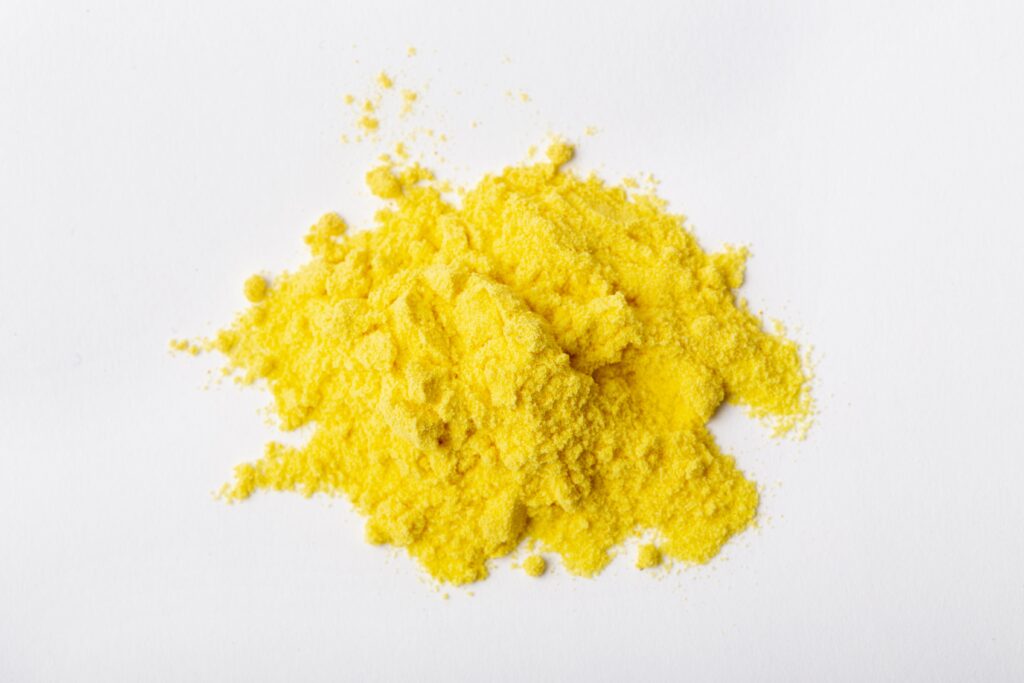
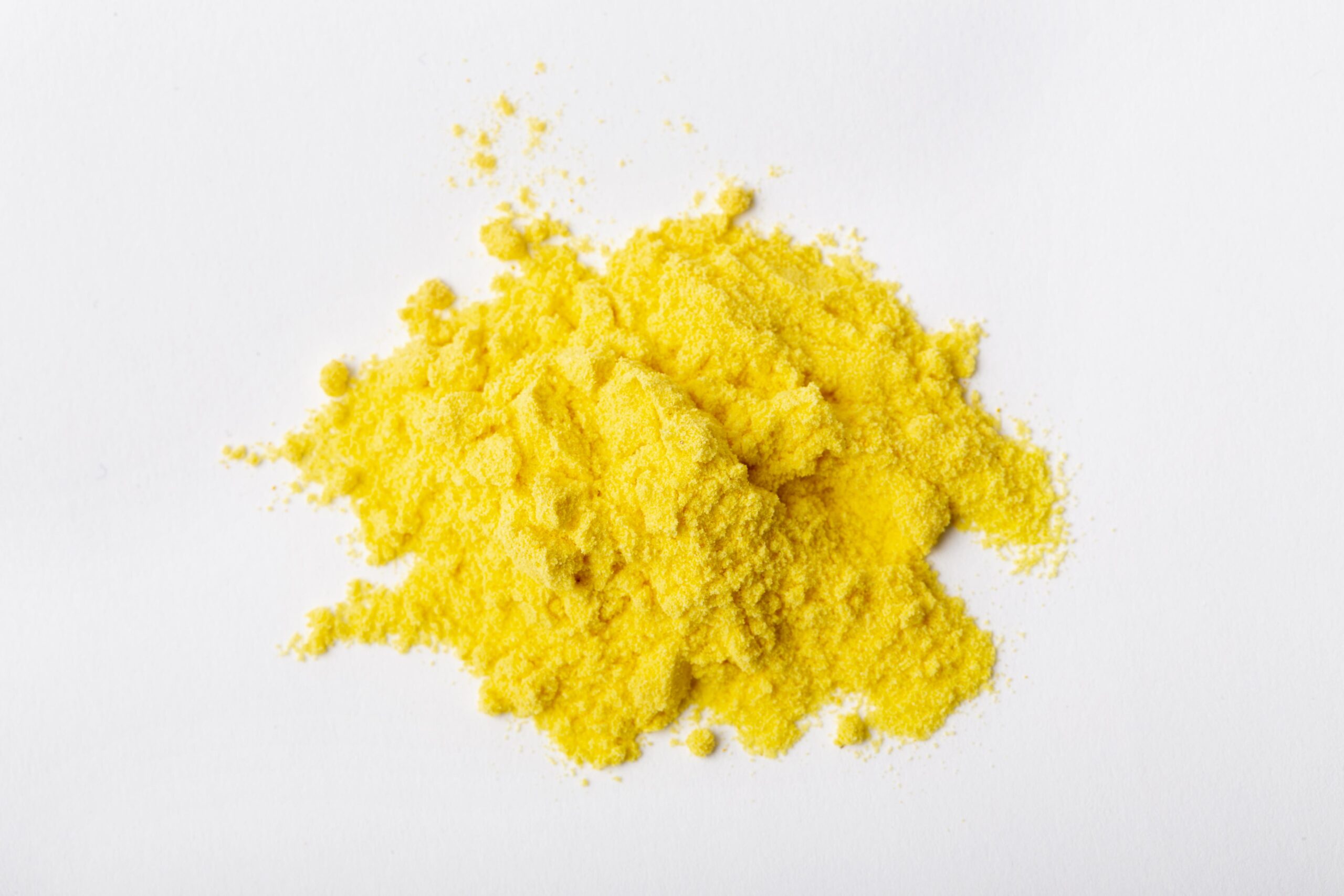
These sulfur-containing formulas are made from imported solid sulfur, landed at Dakar, Abidjan, Douala or Lomé, then burned into sulfuric acid or incorporated into the granule. The 2026 global sulfur crisis pushed the price to 815-820 dollars a tonne FOB Middle East at the end of May 2026 according to S&P Global, with about 47% of the world’s seaborne exports disrupted. The Sahelian States that subsidise the bag absorb part of the shock, with the rest showing up in payment arrears to suppliers. An importer who diversifies origins protects the price of the bag in the village, whether for groundnut fertilizer in Senegal or cotton compound in Mali.
What E-Station does
E-Station supplies solid sulfur to sulfuric acid producers, to manufacturers of sulfur-containing NPK fertilizers and to the importers who serve the groundnut, cocoa and cotton sectors of West and Central Africa, through to the plants that produce groundnut fertilizer for Senegal. The sulfur is offered as granules, pastilles or crushed lump, in bulk or in big bags, with a certificate of analysis per batch and origins outside the Gulf. Our sulfur trading hub presents the available grades, and our pages on sulfur in Senegal, sulfur in Côte d’Ivoire, sulfur in Mali, sulfur in Burkina Faso and sulfur in Cameroon describe the sea logistics through to unloading, on FOB, CFR, CIF or DAP terms.
Frequently asked questions
Groundnut fertilizer in Senegal: which NPK to choose?
The subsidised programme uses NPK 6-20-10 produced by ICS from Taïba phosphate, sold at 6,000 CFA francs per 50 kg bag for the 2025-2026 season according to APS. CIRAD trials show that a supplement of 5 to 10 kg of sulfur per hectare improves pod yield on the soils of the groundnut basin.
How much sulfur should be applied to groundnuts?
The trials published in Oléagineux in 1966 by Bockelée-Morvan and Martin, in Senegal, Upper Volta and Côte d’Ivoire, conclude that 5 to 10 kg of sulfur per hectare are generally enough. The average gain reaches 200 kg of pods and 380 kg of haulms, with a maximum of 900 kg of pods observed at Darou.
Which fertilizer for cotton in Mali and Burkina Faso?
The CIRAD technical manual recommends 200 kg per hectare of a 15-15-15 compound with 6% sulfur and 1% boron at sowing, plus 50 kg of 46% urea about 45 days after emergence. The 50 kg bag is sold at 17,500 CFA francs in Burkina Faso in 2025-2026 and 15,000 CFA francs in Mali in 2026.
Is there a special cocoa fertilizer containing sulfur?
The reference cocoa formulas in Côte d’Ivoire are 0-23-19 and show no sulfur content, and the same goes for the specialities approved in Cameroon. Sulfur reaches the cocoa plantation through the nitrogen carrier, with ammonium sulfate supplying 24% sulfur where urea supplies none.
Why are West African soils short of sulfur?
The 1970 ORSTOM survey measures between 20 and 300 ppm of total sulfur in the soils of tropical Africa, most of them between 50 and 100 ppm, with the lowest values recorded on depleted ferruginous soils and vertisols. Below 8 to 10 ppm of soluble sulfur, the crop responds to a sulfur application.
You produce groundnut fertilizer for Senegal or other sulfur-containing NPKs in Dakar, Abidjan or Douala, or you import sulfur for the groundnut, cocoa and cotton seasons. Go through the Request a quotation form, stating your port of discharge and the target season, and we will build the shipping schedule with you.