
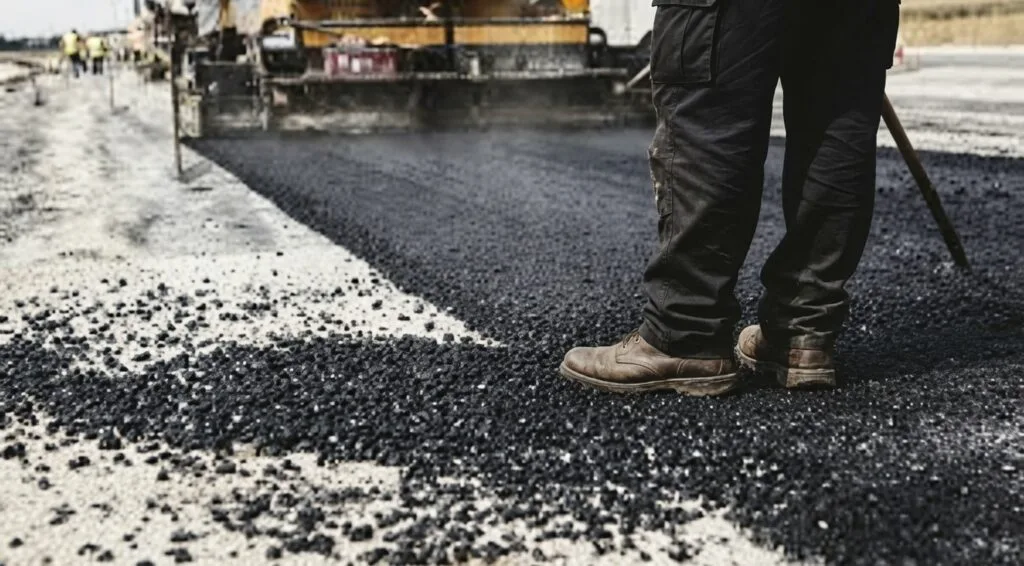
Madagascar, Guinea, Cameroon… Across Africa, major road programmes are boosting bitumen demand. A fast-expanding market, but one that depends on imports and is exposed to global tensions. A breakdown for buyers and infrastructure operators.

The African continent is going through a period of heavy investment in its infrastructure. Roads, motorways, airports: these projects share a common denominator, bitumen. A binder that has become strategic in supporting economic development.
Demand driven by infrastructure
De nombreux pays africains lancent d’ambitieux programmes de construction et de réhabilitation routière. Ces projets, essentiels au désenclavement et au commerce, génèrent des massive bitumen needs, que la production locale ne suffit pas toujours à couvrir.
A market dependent on imports
Most countries on the continent import a large share of their bitumen. This dependence exposes projects to several risks:
- the volatility of global prices, tied to crude oil quotations;
- logistical strains and shipping lead times;
- supply disruptions during periods of geopolitical crisis.
Securing supply: a key challenge
Pour mener à bien leurs projets, les opérateurs africains ont besoin de partenaires fiables, capables de garantir des volumes réguliers et des controlled prices. La sécurisation de la chaîne d’approvisionnement devient un facteur de réussite déterminant.
Key takeaway: the African bitumen market is driven by infrastructure but remains dependent on imports. Global prices and logistics are the main risks. Securing your volumes is essential.
Secure your bitumen supply in Africa
E-Station supports infrastructure players in Africa with their bitumen supply, offering tailored logistics solutions and guaranteed volumes. Contact our experts to secure your projects.
Bitumen in Africa: a market driven by imports and sensitive to prices
Virtually all bitumen in Africa is imported, due to insufficient refining capacity on the continent. This dependence makes buyers particularly exposed to the volatility of international quotations and the cost of sea freight. Following the benchmark indices published by Platts and Argus, as well as market news relayed by Reuters, helps anticipate favourable buying windows and secure volumes at the right time.
For project owners and African public works companies, the challenge is twofold: guaranteeing the availability of grades suited to the climate (hard bitumens for hot regions, 60/70 or 50/70 grades depending on traffic) and controlling the delivered cost on site. A supply structured around firm contracts and reliable port logistics is the best safeguard against shortages.
Your partner for bitumen in Africa
E-Station supplies African markets with road bitumen and petroleum products through an international network of refineries and terminals. We guarantee compliant specifications, full traceability (certificate of analysis) and well-managed logistics right through to destination ports.
Are you running a road project on the continent? Contact our trading team for a firm quote on your bitumen in Africa.
On the same topic:
- Bitumen prices double
- Bitumen market 2026: securing your supply
- Bitumen shortage and road construction projects
The dynamics of bitumen in Africa come down to a simple mismatch: infrastructure needs are surging, while local production remains marginal. Almost all volumes therefore arrive via imports, exposing projects to freight uncertainties and international price swings. For buyers on the continent, the challenge lies as much in securing logistics as in the price negotiated upfront.
Frequently asked questions about the bitumen market in Africa
Why is demand for bitumen rising in Africa?
Many African countries are launching ambitious road construction and rehabilitation programmes, essential for opening up regions and boosting trade, which is generating massive bitumen needs.
Does Africa produce enough bitumen to meet this demand?
No, local production is not always enough to cover requirements, which leaves the continent heavily dependent on imports.
Which African countries are driving this demand?
Several countries are involved, from Madagascar to Guinea and Cameroon, with major road programmes fuelling demand for bitumen.
Why is this market sensitive to global tensions?
Being import-dependent, the African bitumen market is directly exposed to the geopolitical and logistical tensions that affect the global supply of petroleum-based binders.
How can infrastructure operators secure their bitumen supply?
By working with a broker capable of diversifying import sources and anticipating market tensions, it becomes possible to guarantee the continuity of major road programmes.
Aucun commentaire pour l'instant!