
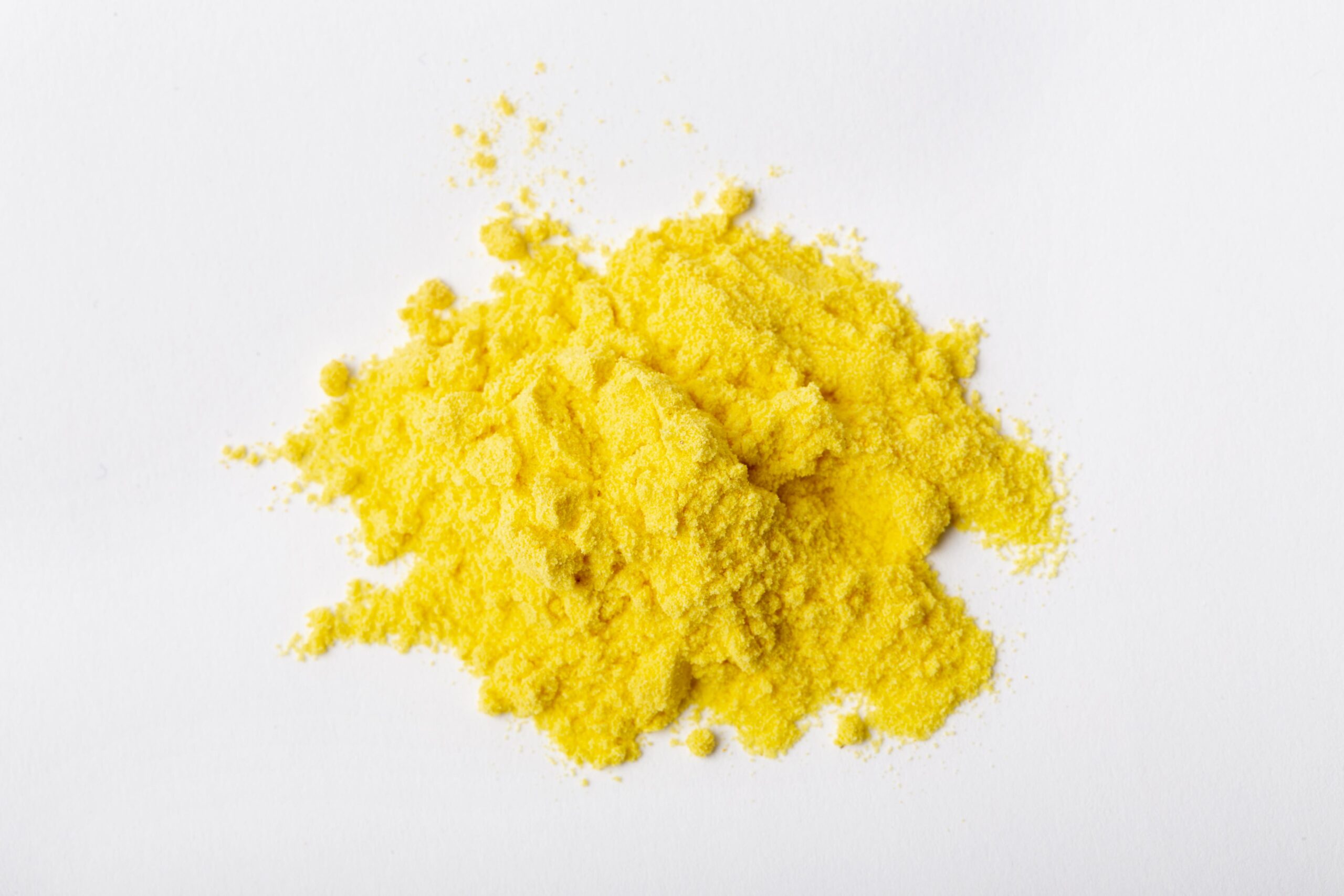
An industrial buyer who receives an offer of granulated sulfur almost always asks for the same documents before opening the commercial discussion: the sulfur technical data sheet, the safety data sheet and the certificate of analysis of the batch offered. These three documents say different things and are drawn up at different times. The first describes a typical product, the second deals with hazards, the third commits the quantity that will be loaded on your vessel. This page explains how to read them in that order, and why the order matters when the cargo is leaving for Morocco, Tunisia or a French port.
What a sulfur technical data sheet must contain
A useful sulfur technical data sheet fits on one page and covers five families of information: the chemical identity of the product, the physical form and particle size, the guaranteed composition with its tolerances, the physical properties that govern storage, and the test methods used for each parameter. Identity is checked in a few seconds: elemental sulfur carries CAS number 7704-34-9 and EINECS number 231-722-6, two references found on any serious document, as shown by this certificate of analysis for granulated sulfur published online. A sheet that omits the test methods leaves the door open to differences of interpretation at the time of inspection.
Particle size deserves a careful reading. Export granulated sulfur is commonly traded in a 2 to 4 mm or 2 to 6 mm size, with a maximum share of fines and a maximum share of oversize on the upper sieve, values found in the standard specifications published for solid sulfur. This parameter determines flowability in the hold, the dust level at unloading and how the product behaves in a feed hopper. A batch that meets the purity requirement but is loaded with fines will prove expensive in port handling.
The parameters of a certificate of analysis and their thresholds
The table below sets out the values that appear on public documents accessible to all: an export specification sheet for solid sulfur and a certificate of analysis for a granulated batch. They give the order of magnitude for a merchant-grade sulfur intended for a sulfuric acid unit. The thresholds in your contract may be stricter, and the batch certificate always takes precedence over the generic sheet.
| Parameter | Typical value for export granulated sulfur | What the value tells you |
|---|---|---|
| Sulfur purity | 99.5 to 99.95% by mass, dry basis | The material yield of your furnace and the tonnage that is actually useful. |
| Ash | 0.03% maximum, i.e. 300 ppm | The mineral load that will stay in the molten sulfur filter. |
| Moisture | 0.5% maximum | The risk of corrosion in the hold and the weight of water you are paying for. |
| Acidity, expressed as H₂SO₄ | 0.003 to 0.005% maximum | How aggressive the product is towards plating and conveyors. |
| Organic matter | 0.03 to 0.05% maximum | The hydrocarbons that colour the acid and foul the catalyst. |
| Particle size | 2 to 4 mm or 2 to 6 mm depending on the specification | Flowability, fines content and dust at unloading. |
| Arsenic, selenium, tellurium, lead | Commercially free | Catalyst poisons and limits on downstream use. |
Purity tells you what you are buying; the other lines tell you what you will have to live with. A batch announced at the best purity level but loaded with moisture and fines will be paid for in crane hours and claims. The page devoted to granulated sulfur covers this point from the loading angle.
Carbon, ash, arsenic and selenium: the impurities to watch
Ash is the first impurity a sulfuric acid unit deals with. The contact process begins with a mandatory operation: the sulfur is melted, filtered to remove ash, then sprayed under pressure into the combustion chamber, as described in the AP-42 manual of the US Environmental Protection Agency. Every excess point of ash means more frequent filter cleaning cycles and inert material that will never produce sulfur dioxide.
Organic matter poses a problem of a different kind. Residual hydrocarbons burn poorly, colour the acid produced and deposit carbon on the catalyst beds. Yet the conversion of dioxide to sulfur trioxide lies between 95 and 98% in a conventional contact plant according to the same EPA document : a few points lost through fouling weigh directly on production and on emissions. Arsenic and selenium, for their part, poison the vanadium pentoxide catalyst lastingly and end up in the acid, which rules out certain downstream uses.
A practical conclusion follows from these three mechanisms: purity is often not the most closely examined line of a certificate of analysis. An operator feeding a sulfur furnace looks first at ash and organics, a fertilizer formulator looks at metals, and an importer reselling in big bags looks at moisture and particle size. This ranking is discussed at the quotation stage, before loading.
Physical properties to find on any sulfur technical data sheet
The physical constants of solid sulfur do not vary from one supplier to another, and their presence on the sulfur technical data sheet serves mainly to size storage and set safety instructions. A public certificate of analysis for granulated sulfur gives the usual values: melting between 115 and 120 °C, boiling at 444.5 °C, density between 1.9 and 2.1 g/cm³, flash point at 207 °C and auto-ignition between 248 and 266 °C. The product is insoluble in water, which simplifies the cleaning of storage areas but does not remove the dust risk.
These constants govern the design of your storage areas: a stock of granulated sulfur is far more vulnerable to sources of ignition and to the build-up of airborne fines than to ambient heat. Density determines silo volume, and the melting point explains why the product travels as a solid and becomes liquid only at the entry to the process.
CLP classification, statement H315 and UN number 1350
The safety data sheet applies the European CLP Regulation. For sulfur, the harmonised classification notified to the European inventory uses statement H315, “causes skin irritation”, with the irritant pictogram and the signal word “Warning”, as summarised in the PubChem entry for sulfur. Some notifications add statement H228 for flammable solid, depending on the form and particle size of the product. The SDS follows the regulatory sixteen-section layout and must be supplied in the language of the country of destination.
On the transport side, solid sulfur travels under UN number 1350, class 4.1 of dangerous goods, information carried by any compliant certificate of analysis. The maritime regime distinguishes between forms: the Carefully to Carry guide from the UK P&I Club classes crushed and lump sulfur in Group B of the IMSBC Code under this UN number, while granulated sulfur falls under Group C. The same guide points out that dry sulfur does not attack steel whereas wet sulfur becomes corrosive, and that a lime wash protects hold structures for about thirty to forty days.
Technical data sheet, SDS and certificate of analysis: three distinct uses
The most common confusion is to treat the sulfur technical data sheet as a contractual guarantee. It describes a typical quality, the one the producer usually makes. The binding document concerns the batch loaded and is produced at the port, on the actual goods. The general terms of sale for sulfur published by a national producer, in this case those ofADNOC for the sale of sulfur, describe the standard mechanics of the market: a jointly appointed independent inspector draws up the certificate of quantity and quality, two representative samples are taken from the loading conveyor and sealed, one stays on board and the other is kept for sixty days.
- Technical data sheet. Typical quality of the product, valid for one origin and one form, useful at the tender stage.
- Safety data sheet. Hazards, operator protection, storage, transport and first aid, in sixteen regulatory sections.
- Certificate of analysis. Results measured on the batch loaded, with methods, date and the inspector’s signature.
- Shipping documents. Bill of lading, certificate of origin, packing list and insurance certificate according to the Incoterm chosen.
A buyer building a quality file asks for all four families together and checks that they are consistent: the size announced must match the one measured on the certificate, and the declared origin must match the loading port on the bill of lading.
How we document every batch of sulfur delivered
E-Station supplies solid sulfur in granulated, pastille and crushed lump form, in bulk or in big bags, with a certificate of analysis per batch and a safety data sheet provided with the offer. Our origins are selected outside the Gulf, a choice that has become decisive since the 2026 global sulfur crisis, and sea logistics are organised through to unloading under FOB, CFR, CIF or DAP Incoterms. You deal with a single contact, from the first exchange of documents to the handover of papers at the port of arrival.
We send the sulfur technical data sheet for the origin offered before any firm quotation, then the batch certificate of analysis before loading. This sequence allows your laboratory to decide on real values and to prepare its counter-analyses on arrival. To understand the whole offer, our sulfur supplier page describes how a first cargo unfolds, and the sulfur trading hub brings together the destinations served. Acid plant operators will find the process side on our page on sulfur for sulfuric acid.
Frequently asked questions
What is the difference between a sulfur technical data sheet and an SDS?
+
The technical data sheet describes the typical quality of the product: purity, ash, moisture, acidity, particle size. The safety data sheet deals with hazards and handling in sixteen regulatory sections, with the CLP classification and storage instructions. The two documents are complementary, and neither replaces the batch certificate of analysis.
Is the certificate of analysis drawn up before or after loading?
+
On the sulfur market, contractual quality is determined at the loading port, by sampling from the conveyor, with an independent inspector, following the practice described in the general terms of sale published by ADNOC. The buyer remains free to have a counter-analysis carried out on arrival, but the loading certificate is generally binding between the parties.
Is solid sulfur a dangerous good in sea transport?
+
Solid sulfur comes under UN number 1350 and class 4.1. The UK P&I Club guide states that the crushed or lump form is declared in Group B of the IMSBC Code, whereas granulated sulfur falls under Group C. The instructions for holds, washing and protection of structures follow from this distinction.
What purity should you ask for to feed a sulfur furnace?
+
A sulfuric acid unit commonly works with sulfur at 99.5% minimum, but the operator looks above all at ash and organic matter, since the process requires the sulfur to be melted and then filtered before combustion according to the EPA AP-42 manual. High purity combined with mediocre ash remains a poor purchase.
Can you send the documents before the order?
+
Yes. The technical data sheet and safety data sheet for the origin offered accompany the quotation, and the batch certificate of analysis is sent before loading. State your downstream use and your destination port in the enquiry, so that we can steer the origin towards the specification that suits you.
Receive the technical data sheet and SDS for your batch
Tell us your tonnage, your destination port and your downstream use. We will send you the documentation for the origin offered with the quotation.
Request a quotation →