
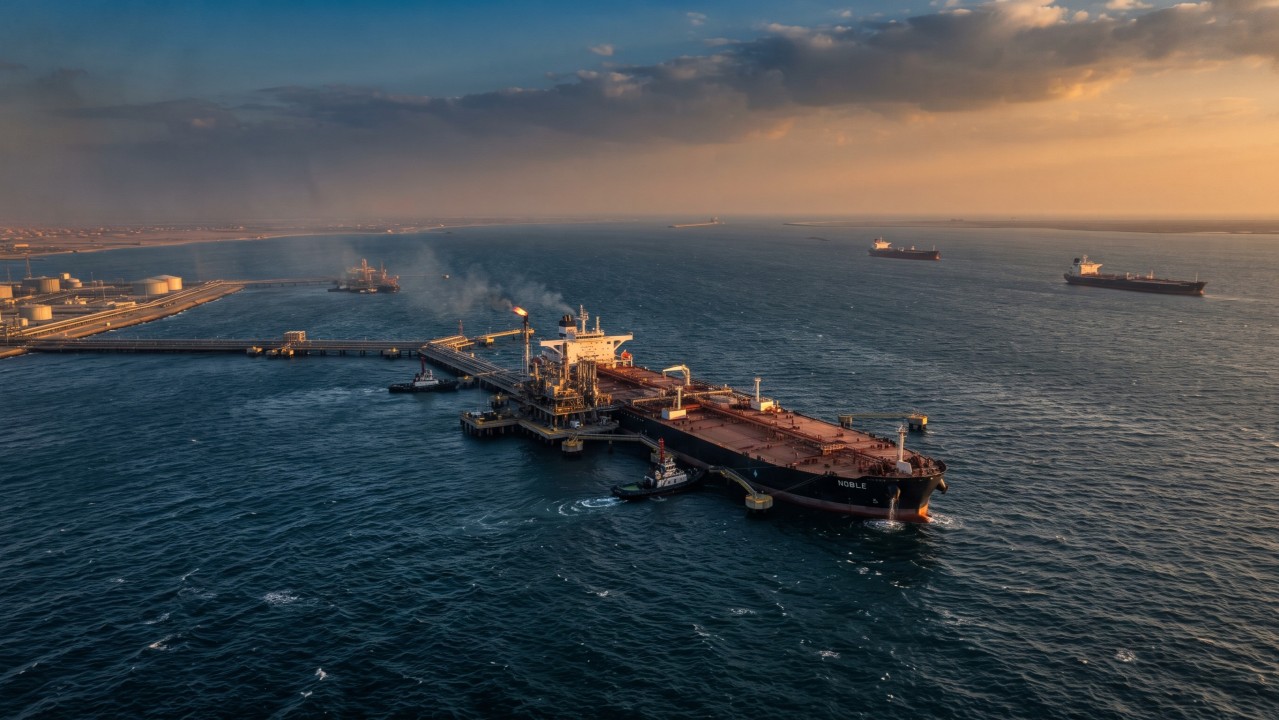
Sulfur for sulfuric acid is the material’s leading industrial outlet: about 90% of the sulfur consumed worldwide is used as sulfuric acid, according to the 2026 review by the US Geological Survey, for world production estimated at 84 million tonnes in 2025. Behind this figure are above all phosphate complexes, which burn sulfur to make the acid that will attack their rock. This page is for those who operate these units and those who supply them, in Morocco, in Tunisia or in Senegal.
From unloading to the sulfur furnace
The product’s journey is short and direct. Solid sulfur arrives at the port in bulk or in big bags, is moved to a covered storage area, then melted and filtered before entering the process. The AP-42 manual of the US Environmental Protection Agency describes this sequence precisely: elemental sulfur is melted, filtered to remove ash, then sprayed under pressure into the combustion chamber. The gas obtained then passes over the catalyst beds, where 95 to 98% of the sulfur dioxide is converted to trioxide before absorption.
Two practical lessons come out of this description. First, everything in your cargo that is not sulfur will end up in a filter, in a purge or on a catalyst bed. Second, melting requires a continuous thermal chain: a break in supply cannot be made up by speeding up the process, and is paid for in a plant shutdown. Combustion itself is strongly exothermic, with gases leaving the burner at around 1,100 °C in the sizing schemes published in university technical literature, heat that is recovered as steam in any modern plant.
How much sulfur for sulfuric acid per tonne produced
The arithmetic of the process is stable and easy to check. One tonne of elemental sulfur gives a little over three tonnes of 100% sulfuric acid, which corresponds to a consumption of about 0.33 tonne of sulfur per tonne of acid in the material balances published in technical literature. In other words, a unit producing 1,000 tonnes of acid a day calls for about 330 tonnes of sulfur a day, i.e. a medium-sized cargo every few weeks.
Downstream, acid consumption depends on the phosphoric process. The environmental review published by a Belgian phosphoric acid producer gives 2.5 tonnes of sulfuric acid per tonne of P₂O₅ in fertilizer grade, and 3 tonnes in purified grade, figures detailed in this scientific article on the dihydrate-hemihydrate process. Combining the two ratios, one tonne of P₂O₅ takes around 0.8 tonne of sulfur. The underlying reaction remains that described by the EPA for the wet process : tricalcium phosphate attacked by sulfuric acid gives phosphoric acid and gypsum.
Quality of sulfur for sulfuric acid and plant yield
An operator who receives sulfur high in ash increases the frequency of filter cleaning and ties up staff on a task with no value. Organic matter poses a more insidious problem: it colours the acid and leaves carbon on the vanadium pentoxide catalyst, which eats into the conversion points that the same EPA manual puts between 95 and 98%. Arsenic and selenium, for their part, poison the catalyst lastingly and limit the uses of the acid obtained.
Moisture deserves particular attention because it acts even before the plant. The Carefully to Carry guide from the UK P&I Club points out that dry sulfur does not attack steel whereas wet sulfur becomes corrosive to hold structures, to the point that a lime wash protects a vessel for only about thirty to forty days. A wet batch therefore opens two fronts: a shipowner’s claim and water that you pay for at the price of sulfur. Details of the parameters to check are on our page on the sulfur technical data sheet and SDS.
Volumes and rates of a phosphate complex
An integrated complex thinks in rates rather than orders. Acid units run continuously, shutdowns are scheduled a year in advance, and the sulfur stock on the ground is an operating reserve expressed in days. Purchase planning therefore follows three simultaneous constraints: the port’s unloading capacity, the volume of the storage area, and the minimum size of an economically defensible cargo. These three factors decide the rhythm of sulfur call-offs far more than the price shown on a given day.
- Port capacity. Crane rate, draught, berth availability and local rules for handling powders.
- Storage. Covered area, mechanical handling, separation of batches by origin to trace any non-conformity.
- Operating reserve. Number of days of consumption covered between two vessels, calculated on the unit’s actual rate.
- Product form. Bulk granules for large volumes, big bags for sites without handling facilities.
Importers and agricultural distributors think differently, with smaller lots, marked seasonality and stricter packaging requirements. We handle both profiles with the same batch documents, whether for sulfur for sulfuric acid delivered to a complex or lots intended for agricultural resale.
Securing an annual chain of sulfur for sulfuric acid
Sulfur travels a great deal: more than half of world elemental sulfur production is traded internationally and less than 2% still comes from mining, as noted by The Sulphur Institute. This material is a by-product of refining and gas processing, which has a major consequence for the buyer: supply does not respond to demand. A refiner does not produce more sulfur because the price rises; it produces as much as its crude contains.
Buying sulfur for sulfuric acid one deal at a time therefore means exposure to a market whose volume is decided elsewhere. The 2026 global sulfur crisis showed what this exposure costs phosphate fertilizer producers. An annual programme spread over several origins, with cargoes matched to the unit’s rate, protects better than a series of opportunistic purchases. The page devoted to the price of sulfur per tonne details how a delivered quotation is formed.
Diversifying origins without lowering the specification
Sulfur for phosphate fertilizers comes overwhelmingly from the recovery units of refineries and sour gas processing plants, which granulate it before export; one national producer in the Gulf thus reports operating twenty-seven recovery units and directing its granulated sulfur primarily to phosphate fertilizers and sulfuric acid. This geographical concentration explains the market’s sensitivity to regional tensions, and the value of opening up substitute origins for the sulfur for sulfuric acid bought each year.
E-Station selects its origins outside the Gulf and organises sea logistics through to unloading, under FOB, CFR, CIF or DAP Incoterms depending on your organisation. Each batch comes with its certificate of analysis, and a single contact follows the file from the first exchange of documents to the handover of papers at the port of arrival. The sulfur trading hub presents all the destinations served, and our sulfur supplier page describes how a first cargo unfolds.
What we take care of through to unloading
Our work begins before the quotation, with a reading of your specification and your port constraints, and ends after berthing, once the documents have been handed over. In between, we frame the origin and form of the product, chartering, insurance according to the Incoterm chosen, inspection at loading and vessel tracking. This continuity avoids the classic situation of a buyer who negotiates goods with one intermediary and transport with another, then has to arbitrate alone when a delay occurs.
For a useful first contact, tell us your monthly consumption, your destination port, your unloading capacity and the sulfur specification your unit follows. These four items are enough to steer the origin and build a serious proposal, including for a programme spread over the year.
Frequently asked questions
How much sulfur for sulfuric acid is needed per tonne of acid?
+
One tonne of elemental sulfur produces a little over three tonnes of 100% sulfuric acid, i.e. about 0.33 tonne of sulfur per tonne of acid in the material balances published in technical literature. A unit’s actual consumption differs little from this value, apart from losses and impurity content.
What purity should you require to feed a sulfur furnace?
+
Units commonly work with sulfur at 99.5% minimum, but ash and organic matter count as much as purity, since the process requires the product to be melted and then filtered before combustion according to the EPA AP-42 manual. State your thresholds and the specification is set to match.
Is sulfur a by-product or a dedicated production?
+
Elemental sulfur is very largely recovered from refining and sour gas processing, with mining accounting for less than 2% of world production according to The Sulphur Institute. Supply therefore follows oil and gas activity rather than fertilizer demand.
What share of the world’s sulfur goes to sulfuric acid?
+
About 90% of the sulfur consumed is used as sulfuric acid according to the 2026 review by the US Geological Survey, and phosphate fertilizer manufacture is its main use. This concentration explains the close correlation between the sulfur market and the fertilizer market.
Can you deliver an annual programme rather than a one-off cargo?
+
Yes. We build programmes spread over the year, with cargoes matched to your unit’s rate and several origins to limit exposure to a single region. Tell us your monthly consumption and your destination port to obtain a proposal.
Secure the feed to your acid unit
Give us your monthly consumption, your port and your specification. We come back with an origin, a product form and a delivered quotation.
Request a quotation →