
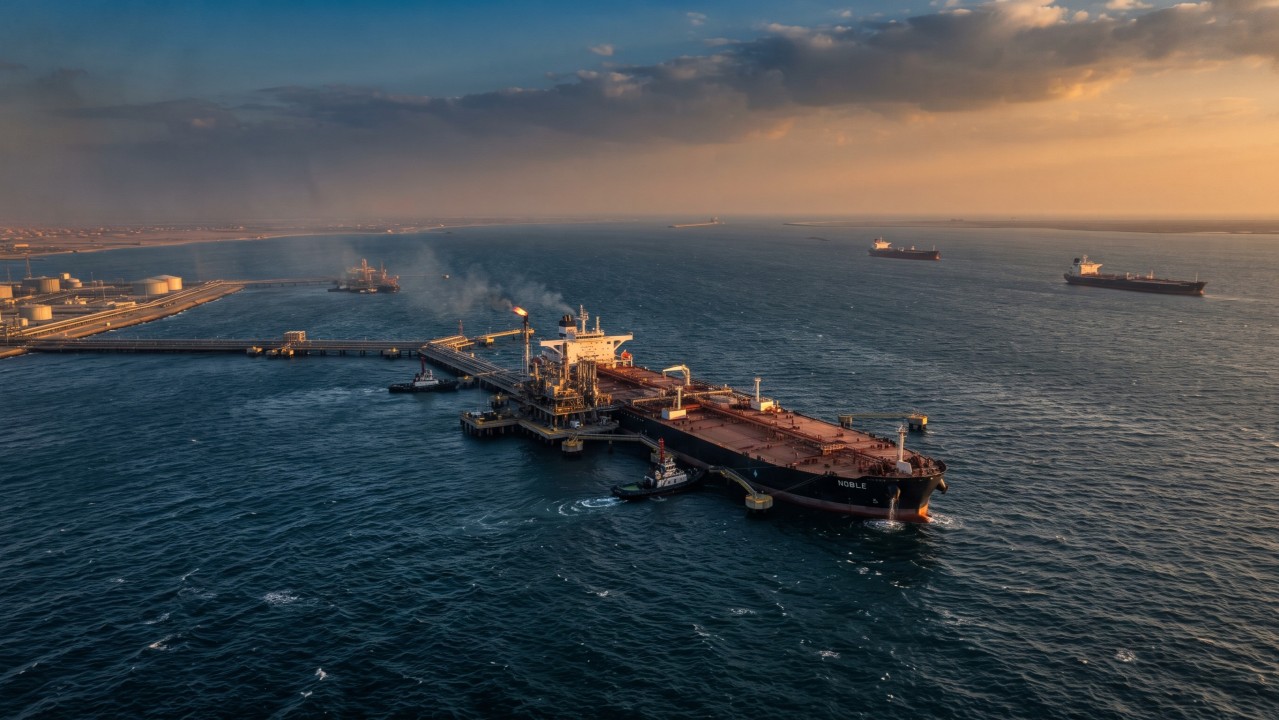
A purchasing director who receives two offers on the same morning rarely compares like with like. The price of sulfur per tonne quoted by a seller may refer to a value at the loading port, a value delivered to the destination port, or a value delivered to your site after unloading and trucking. Until the Incoterm has been set, the gap between two proposals says almost nothing about their competitiveness. This page describes the items that make up a quotation, the state of the market as documented by public sources, and how E-Station builds a firm offer for solid sulfur in granules, pastilles or crushed form.
What a price of sulfur per tonne actually contains
The first line of a quotation is the value of the product loaded on board at the port of origin, what traders call FOB origin. It depends on the refinery or gas processing plant that recovered the sulfur, the quantity available on the quay when the vessel arrives, and the number of buyers competing for the same loading window. Then come sea freight, cargo insurance when the Incoterm makes it the seller's responsibility, port charges and handling. One item remains that many offers leave out: the cost of time spent at the quay.
A charter party grants the cargo an agreed number of hours to load and then to discharge. Beyond this laytime, the charterer owes the shipowner compensation that the Shipowners’ Club describes as the liquidated payment for exceeding laytime. A congested port, an immobilised crane or a full storage area can then turn an attractive quotation into an unpleasant bill. We prefer to build this risk into the price of sulfur per tonne, and say so, rather than leave it outside the contract.
- FOB origin value of the solid sulfur loaded on board at the port of departure, excluding transport.
- Sea freight chartering of the vessel or container to your discharge port.
- Cargo insurance cover of the goods during the voyage, paid by the seller under CIF.
- Port charges handling, weighing, sampling and immobilisation of reclaiming equipment.
- Demurrage compensation due when loading or discharge exceeds the agreed laytime.
Sulfur prices: where the market stands in 2026
The statistical starting point is solid. The USGS estimates world sulfur production at 84 million tonnes in 2025, including 19 million tonnes for China alone, and records an average ex-works unit value for elemental sulfur that rose from 46 dollars per tonne in 2024 to 180 dollars per tonne in 2025, according to the Mineral Commodity Summaries 2026. The same publication notes that about 90% of the sulfur consumed is used in the form of sulfuric acid, which explains why phosphate complexes react immediately to any tension.
The rest played out within a few months. The University of Illinois farmdoc daily service traces a Vancouver spot price below 100 dollars per tonne in early 2024, above 400 dollars per tonne at the end of 2025, then close to 1,040 dollars per tonne in summer 2026. At the end of May 2026, S&P Global Commodity Insights recorded Middle East FOB at 815-820 dollars per tonne and CFR Brazil at 1,200 dollars per tonne, two assessment records.
The markets that concern us directly followed. The CRU Sulphur review recorded at the same time a QatarEnergy quarterly contract settled at 740 dollars per tonne FOB, CFR Mediterranean between 920 and 940 dollars per tonne and CFR India between 800 and 850 dollars per tonne. For a Moroccan, Tunisian or Senegalese buyer, the relevant order of magnitude lies in this Mediterranean range, adjusted for the real freight to their port and the speed at which they can empty a hold.
This surge stems from supply rather than demand. The American farm press, in a September 2026 update, points out that a large share of traded sulfur leaves the Middle East and passes through the Strait of Hormuz, and attributes the supply contraction to damage to refining and processing facilities. We have detailed this sequence in our analysis of the 2026 global sulfur crisis.
FOB, CFR, CIF and DAP give four prices for the same cargo
The International Chamber of Commerce Incoterms 2020 rules reserve FAS, FOB, CFR and CIF for sea and inland waterway transport, while DAP is used for any mode. The 2020 revision grouped all the costs specific to each rule into a single article, A9 and B9, precisely so that a buyer can read them in one place. An FOB offer leaves freight and insurance to you, a CFR offer includes freight without insurance, and a CIF offer adds cover whose default level remains that of the Institute Cargo Clauses (C).
DAP deserves particular attention when unloading is a problem. Under this rule, the seller brings the goods to the agreed place and makes them available without unloading them, which leaves the consignee responsible for reclaiming and equipment. An importer who discovers this nuance at berthing pays for the discovery in demurrage. We set out the split item by item on our page on incoterms applied to sulfur, and the same documentary logic is explained for bitumen purchasing.
Spot, quarterly contract or indexed annual contract: three ways to buy
Buying cargo by cargo exposes you fully to the volatility described by the figures above. The quarterly contract offers intermediate visibility and serves as a market benchmark, as shown by the QatarEnergy contract, whose level is publicly commented on by CRU at each revision. Finally, the indexed annual contract sets volumes and a lifting schedule and lets the price follow an agreed reference, which protects the plant from the risk of shutdown without freezing a value that nobody can hold for twelve months.
The choice depends mainly on your storage capacity. A complex holding three weeks of consumption in a covered pile can afford to wait for a market window. A unit living on ten days of stock needs a firm arrival schedule, and the price of sulfur per tonne becomes secondary to regularity. We discuss this trade-off before proposing a structure, because it determines the form of the contract as much as the final figure.
Form and packaging affect the price of sulfur per tonne
Formed sulfur, obtained by solidifying molten sulfur into granules or pastilles, corresponds to an identified category of the maritime code for solid bulk cargoes, with a particle size of about 1 to 10 mm, a bulk density of 900 to 1,350 kg per cubic metre and a stowage factor of 0.74 to 1.11 cubic metres per tonne according to the schedule SULPHUR (formed, solid) of the IMSBC Code. These values determine how a hold is filled and therefore the unit freight.
Packaging then adds its own layer. A big bag costs the bag, filling, container stuffing and containerised freight, whereas bulk in the hold spreads fixed costs over several thousand tonnes. Part of the gap is recovered at unloading, when a port without a grab crane makes the container quicker to handle. We compare the two schemes with figures on our page on sulfur in big bags or in bulk, and the tolerances of the product itself are detailed on our page on granulated sulfur.
Getting a firm quotation for your discharge port
A useful quotation requires a few precise details from you: the discharge port, the tonnage and schedule you want, the target Incoterm, the form and packaging, and the quality constraints of your process. From there we work on an origin outside the Gulf, check the draught and reclaiming equipment, and come back with a delivered price of sulfur per tonne, with a certificate of analysis per lot and an arrival schedule. Our full offer is presented on our hub dedicated to sulfur trading.
Benchmarks vary widely from one market to another, and we publish dedicated pages for the destinations we serve most. A buyer in the Kingdom of Morocco will find the port and customs specifics on sulfur prices in Morocco, a Tunisian importer on sulfur prices in Tunisia, and an Algerian operator on sulfur in Algeria. If you are new to this market, the sulfur supplier page describes the full course of a first cargo.
Frequently asked questions
What is the price of sulfur per tonne today?
+
No single figure applies to every port. Public assessments in May 2026 put Middle East FOB at 815-820 dollars per tonne according to S&P Global and CFR Mediterranean between 920 and 940 dollars per tonne according to CRU. Your delivered price will depend on the real freight and your Incoterm.
Why do two suppliers quote such different sulfur prices?
+
Most often because the two offers do not use the same Incoterm. An FOB value and a CFR value are separated by sea freight, which weighs heavily on a long voyage. Also check the product form, the packaging and the split of unloading costs before concluding that there is a gap in competitiveness.
Does a CFR quotation cover unloading at the port?
+
CFR makes freight the seller's responsibility, with no obligation to unload. The Incoterms 2020 rules list all the costs of a rule in articles A9 and B9, which settles the question as soon as the contract is read. DPU is the only rule under which the seller actually unloads.
Can a sulfur quotation be fixed for twelve months?
+
In a market where the Vancouver spot price rose from less than 100 dollars per tonne in early 2024 to about 1,040 dollars per tonne in summer 2026 according to farmdoc daily, nobody holds a fixed price for a year. The workable formula remains a volume contract indexed to a published reference, with a committed arrival schedule.
Does the big bag change the price of sulfur per tonne?
+
Yes, in both directions. The bag, filling and container stuffing raise the cost of the tonne shipped, while container unloading sometimes avoids costly hours of laytime in a poorly equipped port. The trade-off is made on the full delivered cost, rather than on the goods line alone.
Get a delivered price for your port
Give us your discharge port, your tonnage and your target Incoterm, and we will come back with a quotation built item by item. A single contact follows the file through to unloading.
Request a quotation →