
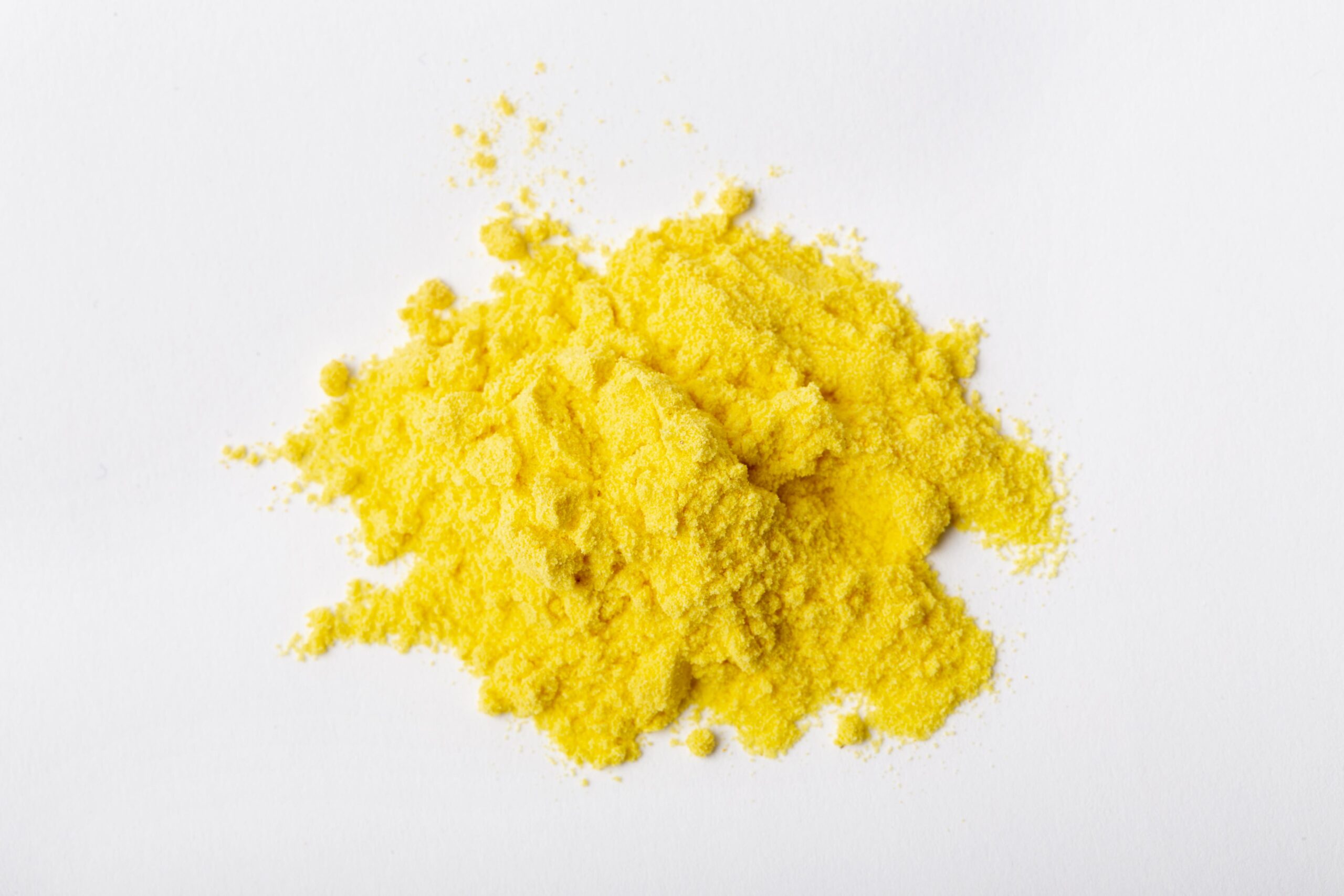
Granulated sulfur has become the norm in seaborne trade for a very practical reason: it flows through a hopper, can be picked up by grab and stores without caking, whereas sulfur cast in slabs has to be crushed before use. A buyer comparing two offers looks first at the stated purity, although the parameters that make the difference in use are the actual particle size, the fines content and the residual moisture. This page describes the quality we supply, how it is checked and what it changes at unloading and at the furnace.
Standard export granules and their tolerances
The material comes from natural gas sweetening and oil refining, then goes through granulation, which turns liquid sulfur into calibrated beads. The reference commercial size is between two and six millimetres, with a minority share tolerated outside the range. The batch sheet published for a grade 9998 granulated technical sulfur (Rosneft, Bashneft-Ufaneftekhim) thus requires at least 92% of the mass to fall within the 2 to 6 mm range, and sets a tapped density of at least 1,100 kilograms per cubic metre. These two figures govern the hold volume to be reserved.
Chemical composition comes under the GOST 127.1-93 standard, whose grades serve as a common language between sellers and buyers on the export market. A grade 9995 lump batch published by the Saratov refinery shows the level of requirement applied to impurities under this same standard. When you ask a trader for granulated sulfur, state the target grade rather than a purity figure alone: purity by itself says nothing about ash, acidity or free water.
Specifications of export-quality granulated sulfur
The table below sets out the limits published on the two batch certificates cited above. It gives an order of magnitude for the market and serves as a basis for drafting the quality clause of your contract.
| Parameter | Grade 9998 limit (granulated) | What the parameter determines |
|---|---|---|
| Sulfur content | 99.98% minimum | Conversion yield and furnace load |
| Ash | 0.02% maximum | Fouling of filters and catalyst |
| Organic matter | 0.01% maximum | Acid colour and combustion by-products |
| Acidity (as sulfuric acid) | 0.0015% maximum | Corrosion of holds, hoppers and conveyors |
| Moisture | 0.2% maximum | Caking in storage and corrosion in the hold |
| Particle size | 2 to 6 mm for at least 92% of the mass | Flowability, fines content, dust |
| Tapped density | 1,100 kg/m³ minimum | Hold volume and filling of big bags |
| Mechanical impurities | none | Blocking of screws and screens |
The left and middle columns come from the public documents of Rosneft cited above. The right-hand column reflects operating experience and should be discussed with your process teams. The specification that binds you contractually remains that of the certificate of analysis issued on your batch by an independent laboratory, before loading. Our page on the sulfur technical data sheet and SDS explains how to read this document.
Why sulfuric acid producers prefer granules
Nearly 90% of the sulfur consumed worldwide is used as sulfuric acid, according to the USGS Mineral Commodity Summaries 2026, and most of this acid goes into phosphate fertilizer production. In a contact plant, solid sulfur is melted and then burned; a regular feed to the melter determines the stability of combustion and, downstream, conversion on the catalyst beds. A uniform size gives regular melting, a predictable flow and fewer cleaning shutdowns.
That is why a phosphate complex agrees to pay for one form rather than another at equivalent sulfur content. Ash and organic matter end up as filter sludge after melting, and every point gained on these two parameters lightens maintenance. Acidity and free water, for their part, attack handling equipment well before reaching the furnace. Buyers in Morocco and Tunisia, where the phosphate sector absorbs most of the imported volumes, in fact frame their tenders around these parameters rather than purity alone.
Flowability, fines content and dust at loading
Here is the subject no one mentions before the first unloading. Granulated sulfur abrades during handling and transport, and every transfer produces fines. These fines reduce flowability, load the air in the shed and increase the risk of a dust cloud igniting. North American port operators commonly spray the material during operations to keep dust down, a practice described in the guide Carefully to Carry from the UK P&I Club.
- Number of transfers : every additional handling between granulation and your hopper creates fines.
- Storage time and conditions : an open-air stockpile takes up moisture, which makes acidity migrate and the beads stick together.
- Drop height at loading : a free fall from a conveyor breaks more granules than guided loading.
- Date of analysis : a certificate issued at loading describes a material closer to what you will receive than an old production analysis.
We frame these points in the contract by fixing the time of sampling and the laboratory used. A trader who sells granulated sulfur without discussing the date of analysis is selling a theoretical specification.
Bulk in the hold or containerised big bags
Bulk suits sites with a port berth, handling machinery and a dedicated storage area. Containerised big bags serve importers and distributors who redistribute the goods from a dry warehouse, without investing in heavy handling. The maritime classification differs by form: sulfur formed into granules or pastilles falls under Group C of the IMSBC Code, while crushed or lump sulfur falls under Group B and class 4.1 of the IMDG Code, as stated in the same guide from the UK P&I Club. This difference affects access to certain ports and the cost of chartering.
The presence of free water makes sulfur corrosive to hold structures, which explains the cleanliness requirements and sometimes the preventive lime-washing of holds before loading. We always price both scenarios, bulk and containers, on the same enquiry, so that the comparison is made on the tonne delivered to your site. The detailed reasoning is on our page on sulfur in big bags or in bulk, and local port constraints are covered on our pages for delivery to Senegal.
Physico-chemical properties and safe handling
Elemental sulfur has CAS number 7704-34-9 and EC number 231-722-6, according to the INERIS chemical substances portal, which lists hazard statement H315, skin irritation. A safety data sheet published by the producer Hess puts melting between 112.8 and 120 °C, boiling at around 444 °C, the flash point at around 207 °C and auto-ignition at around 232 °C, and classifies the material as a category 2 flammable solid, statement H228.
The same sheet notes that hydrogen sulfide can accumulate in confined spaces in contact with solid sulfur, a point that governs procedures for entering holds and silos. The practical consequence: storage is in the dry, away from oxidisers and sources of ignition, with active dust management. These points are set out in the safety data sheet that accompanies every shipment.
Ordering granulated sulfur from E-Station
Send us the target quantity, the grade or specification expected, the destination port and the Incoterm you have in mind. We reply with an offer that names the region of origin, the loading window and the proposed inspection laboratory, on FOB, CFR, CIF or DAP terms. Our origins are selected outside the Gulf, a choice that the 2026 global sulfur crisis has made decisive for continuity of supply. The general framework of our business is presented on the page on sulfur trading and supply, and our full offer under sulfur supplier.
Frequently asked questions
What particle size for export granulated sulfur?
+
The reference size runs from 2 to 6 mm, with a tolerated share outside the range: the batch sheet for Rosneft grade 9998 requires at least 92% of the mass within this range. Have the agreed value and the sieving method written into the contract.
Is granulated sulfur classed as dangerous for sea transport?
+
In granulated or pastille form, it falls under Group C of the IMSBC Code, less restrictive than crushed sulfur, which is classed in Group B and class 4.1 of the IMDG Code, according to the UK P&I Club. Always check acceptance by the destination port.
How are granules stored after receipt?
+
In the dry, under ventilated cover, away from oxidisers and any source of ignition, with a dust management plan. A stock exposed to the weather takes up moisture, which raises acidity and degrades flowability. The safety data sheet supplied with the shipment sets out the applicable instructions.
Do you supply a certificate of analysis per batch?
+
Yes. Every shipment is covered by a certificate of analysis drawn up by an independent laboratory at loading, together with the weight certificate. The laboratory is named in the contract, as are the sampling method and the handling of quality deviations.
Get a quotation on your exact specification
State the expected grade, the quantity, the packaging and the destination port. We reply with the origin, the loading window and the proposed inspection laboratory.
Request a quotation →